Audio is no longer the bottleneck. The real question for any team that records calls, depositions, focus groups, lectures, or podcasts is which kind of transcript they actually need — and how much they should pay for it. AI transcription has become genuinely good for clean audio with one or two speakers. Human review is still essential anywhere a wrong word can cost money, credibility, or a case.
This guide is a practical decision tool, not a vendor pitch. It explains where pure AI is enough, where human review pays for itself, the hybrid middle path most teams settle on, and a 60-second checklist you can use before sending the next file out for transcription.
Need a quick quality check? Upload 2–3 minutes of audio and we’ll send back a recommendation — AI-only, human review, or hybrid — with a price.
Get a recommendationWhen AI alone is enough
Modern automatic speech recognition (ASR) — Whisper-class models, in particular — handles a surprisingly wide band of recordings well. If your audio meets all three of these conditions, an unedited AI transcript is usually fine:
- Clean source. Lavalier or close-mic, low room reverb, no background music or HVAC noise.
- One or two speakers, low overlap. Solo monologues, prepared interviews where the host yields cleanly, or two-person calls with a moderator.
- Low downstream stakes. Internal notes, brainstorming captures, drafts you’ll re-read against the audio anyway.
For these cases, a $0–5 ASR run can save hours and produce a document that is 92–96% word-accurate. Errors that remain are usually proper nouns, domain jargon, and a handful of homophones — survivable for a meeting note, dangerous for a court filing.
When you need human review
Human review starts paying for itself the moment a recording carries any of these properties:
- Many speakers, frequent overlap. Focus groups, depositions with co-counsel, panel discussions. AI accuracy drops sharply, and speaker separation becomes guesswork.
- Specialised terminology. Medical, legal, scientific, or industry jargon where a single wrong word changes the meaning. AI does not know that “pro se” is a legal term, not a typo.
- Citation or filing. Anything that will be quoted in a published article, attached to court documents, or audited by a regulator.
- Difficult audio. Phone recordings with codec compression, on-site interviews with traffic, intercom calls, body-worn camera footage.
For these recordings, a human-edited transcript reaches 98–99.5% accuracy and — more importantly — labels speakers correctly, marks the inaudible passages explicitly, and preserves the wording that actually matters. Our team handles this kind of work every day across legal transcripts and research interviews.
The hybrid middle path
Most teams that ship transcripts at scale do not pick one extreme. They run an AI draft first, then send only the risky portions for human review. The result is a 5–10× cost reduction compared to fully manual transcription with an accuracy outcome that is indistinguishable in practice.
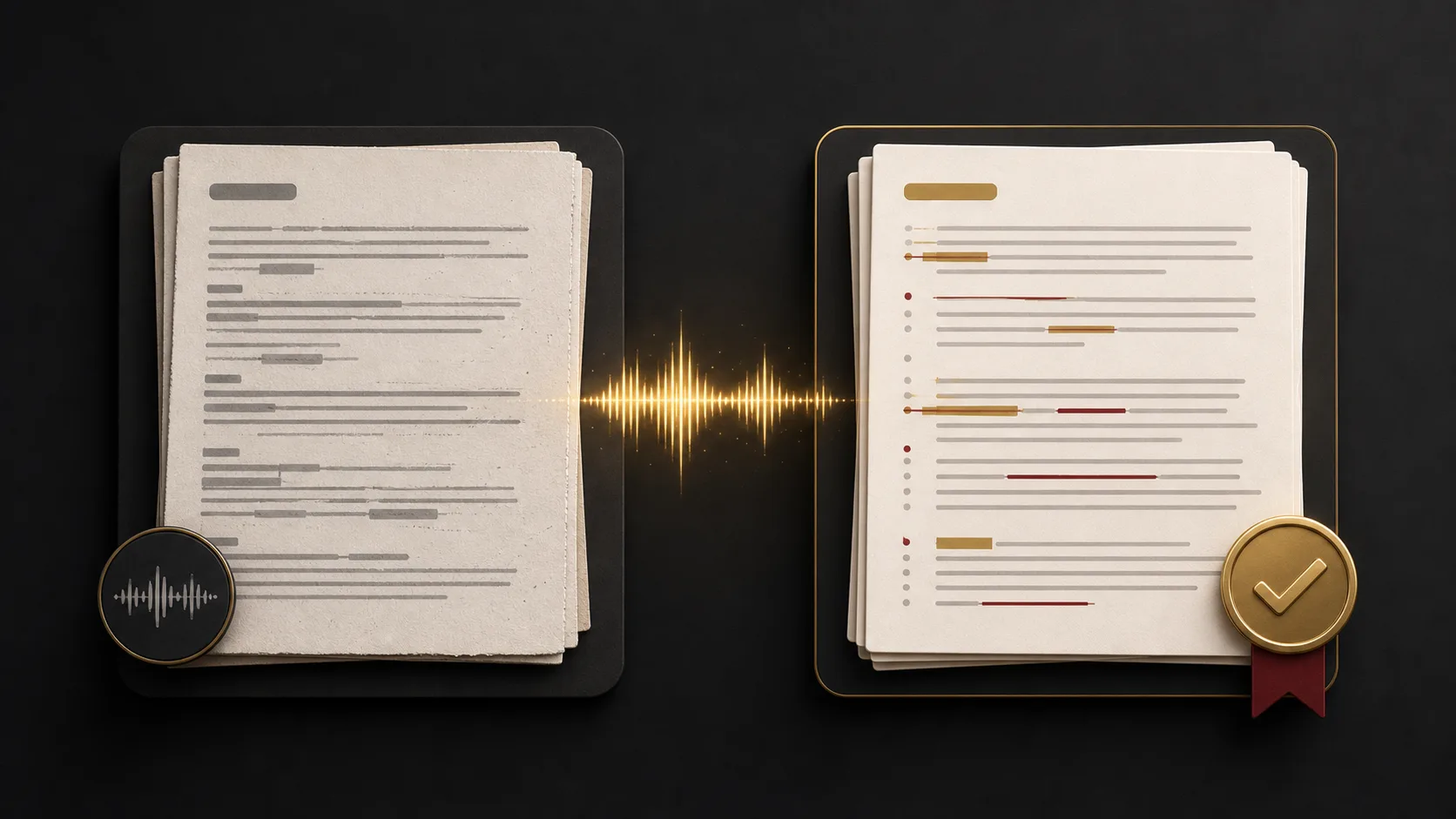
The hybrid flow looks like this in practice:
- Upload the recording. AI produces a first-pass transcript with timestamps and speaker labels.
- An editor reviews high-risk passages: legal/medical terminology, speaker handovers, inaudible markers.
- The editor corrects the draft, normalises formatting, and flags any sections the audio cannot resolve.
- The transcript ships in the format your downstream workflow needs — DOCX for review, SRT for subtitle workflows, JSON or CSV for analysis.
Cost and accuracy table
Real numbers, per audio hour, US market 2026 prices:
| Workflow | Accuracy | Per audio hour | Best for |
|---|---|---|---|
| AI only (Whisper-class) | 92–96% | $0–5 | Internal notes, drafts, brainstorming |
| AI + light human pass | 97–98% | $15–22 | Podcasts, lectures, internal interviews |
| Hybrid with full human review | 98.5–99% | $24–32 | Research, journalism, business interviews |
| Full human-edited (single speaker) | 99–99.5% | $24–35 | Single-source business or research audio |
| Full human-edited, certified | 99–99.5%, sworn | $44–60 | Legal, dispute, evidence-style recordings |
For complete pricing across formats and rush options see the transcription pricing page.
Have a specific recording? Send the file or a 2-minute sample and we’ll quote the right workflow with a same-day estimate.
Send your fileDecision checklist before you publish or file
Run any recording through these five questions before deciding the workflow. Three or more “yes” answers means human review pays for itself.
- Number of speakers and overlap level. Three or more speakers, or visible cross-talk in the recording? → human review.
- Domain-specific terminology risk. Legal, medical, scientific, or strong company jargon? → human review.
- Legal or compliance exposure. Will this transcript be filed, deposed, or audited? → human review, certified.
- Publication or citation sensitivity. Will direct quotes appear in an article, paper, or marketing? → human review.
- Turnaround requirement. Need it in 12 hours? → rush human pass; hybrid flow runs in parallel and saves 30–40% of the editor cost.
FAQ
When is AI transcription enough on its own?
AI-only transcripts are often enough for internal notes, brainstorming, and low-risk drafts when audio is clean and speaker overlap is minimal.
When should I add human review?
Use human review for legal, research, publication, and client-facing outputs where terminology accuracy and speaker attribution must be reliable.
How can I reduce cost without risking quality?
Use a hybrid flow: AI draft first, then targeted human review on critical sections, difficult audio, and terminology-heavy passages.
Does speaker overlap affect transcription quality?
Yes. Overlap increases error rates in AI transcripts and makes speaker separation harder, which is one of the strongest signals for human review.
Have a recording? Send it.
Upload audio or video. We’ll send a transparent estimate within an hour and confirm the deadline before you pay.
Upload audio