Podcast transcript to blog post that keeps your voice
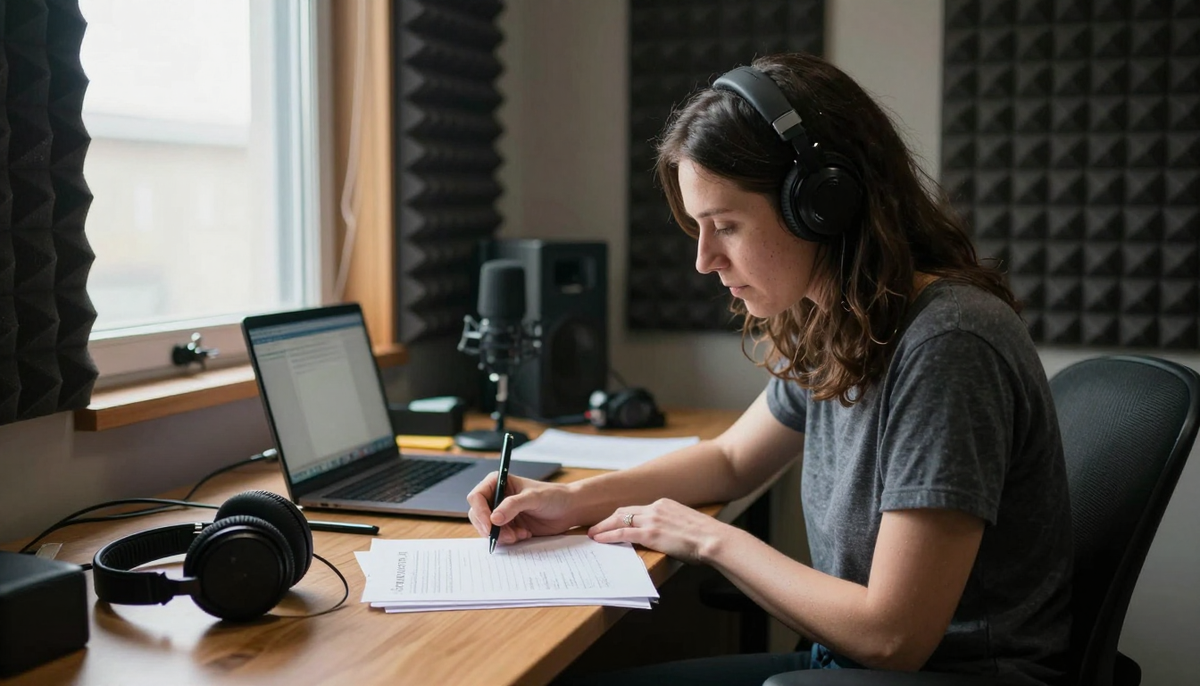
To turn a podcast transcript into a blog post without losing your voice, start with an accurate transcript, cut the repetition that listeners needed but readers don't, and leave your most distinctive wording alone. This guide is for podcasters, solo clinicians, small law firms, researchers, home health agencies, and service businesses that want written articles to sound like the person behind the microphone.
Why do podcast transcripts read badly on the page?
In 1948, Bell Labs mathematician Claude Shannon published "A Mathematical Theory of Communication," the founding work of information theory. Its central idea is that information can be measured as surprise. The more easily you can predict the next word in a message, the less new information that word delivers.
This wasn't obvious, because people naturally linked information with meaning. Shannon set meaning aside and asked a stranger question: how uncertain is the receiver about what comes next? That shift allowed engineers to measure messages precisely, and it made predictable parts of language look useful in a new way.
Shannon called that predictability redundancy, and it protects messages from noise. If a phone line drops a word, you can often work out what was missing from the rest of the sentence. Redundancy may look wasteful, but it helps a message survive an imperfect channel.
Shannon was analyzing signals rather than prose style, but his logic gives editors a useful test. A podcast listener may be driving or washing dishes and can't easily glance back at the last sentence, so natural speech repeats and circles back. A reader can reread at will, so much of that protection is no longer needed.
The page also removes tone, pauses, and laughter, so your writing must sometimes add clarity that your voice once supplied. This leads to the rule behind the rest of this guide:
- Cut redundancy that only served the audio format.
- Add signals for meaning that your voice carried.
- Protect surprise, because your unexpected word choices are a large part of what makes you recognizable.
Have a recording that needs an accurate transcript? An editor listens to the full recording and checks the entire transcript. Send it for an individual quote.
How to prepare a podcast transcript before you rewrite it
Don't start rewriting until you trust the source. A transcription error can read perfectly well, especially when a wrong word is more common and more predictable than the one you actually said. Automatic drafts can make this kind of substitution, and a quick read won't always catch it because the sentence still seems fine.
The words most at risk are often the ones that matter most: names, technical terms, drug names, case names, and unusual phrases. Check the transcript against the audio, and mark who is speaking wherever that could be unclear. Keep the recording open as you edit so you can hear how a line was delivered.
Next, listen for the moments that sound most like you. Highlight sharp comparisons, strong opinions, and phrases you repeat from episode to episode. These lines are the raw material for your post, so mark them before you start cutting.
How to edit a transcript into a blog post: a step-by-step checklist
- Choose one question. An episode may cover many topics, but a post should resolve one question a reader would actually search for.
- Pull the relevant passages. Copy them into a new document instead of editing the full transcript from top to bottom.
- Reorder for readers. Conversations often reach the main point late, so put your answer near the top.
- Remove audio scaffolding. Cut false starts, filler, recaps, and phrases such as "as I was saying."
- Keep your highlighted lines. Change them only when they are unclear or inaccurate.
- Replace missing tone. If sarcasm or doubt was audible, make it clear in the wording.
- Add context. Explain any reference that made sense only during the conversation.
- Check quotes and permissions. Make sure guests are quoted fairly and are comfortable with how their words will be used.
- Review sensitive content. Remove identifying details where needed, and have the appropriate person review legal, clinical, or confidential material before publication.
- Read it aloud. Stop wherever you think, "I would never say that," and rewrite that sentence in your own words.
For example, imagine an estate planning attorney saying on a podcast, "A will is a letter to people who are already upset with you." An eager editor might change this to "A will is an important document that can help reduce family conflict." The revised sentence is tidy and predictable, and it could have come from anyone.
A better edit keeps the original line, then adds what a reader needs: "A will is a letter to people who are already upset with you. So write it clearly enough that nobody has to guess what you meant." The voice stays, the point is clearer, and the attorney can then check that the advice is presented accurately.
Common mistakes and how to avoid them
- Publishing the transcript with light cleanup. Readers get all of the audio's repetition without the speaker's tone. Restructure the material around one question instead.
- Polishing away your personality. Heavy editing tends to replace unusual choices with safe ones. Compare the edited version with your highlighted lines and restore anything you lost for no good reason.
- Keeping every "um" for authenticity. Filler isn't the same as voice. Your word choices, rhythm, and point of view are what readers will recognize.
- Editing from an unverified transcript. An error in the source can carry straight into your post. Check key terms and quotes against the recording.
- Tightening a quote until it changes meaning. Removing a hedge such as "in some cases" can turn a careful statement into a sweeping one. Keep the qualifications that affect meaning.
- Trying to cover the whole episode. A post that summarizes everything rarely answers anything well. Save strong secondary topics for separate posts.
What you can do yourself and when to use a professional transcription service
You can probably handle the entire process yourself if your episodes are short, the audio is clean, and you have time to check the transcript against the recording. The rewrite may also be best left to you or someone who knows your voice well. Your judgment about what you meant is difficult to outsource.
Handing off the transcription may make more sense in these situations:
- Your recordings are long, or several people talk over one another.
- The conversation includes specialized legal, clinical, or research terminology.
- You plan to quote guests directly, so exact wording matters.
- You keep postponing articles because checking the transcript takes too long.
Keep in mind that this kind of service solves the source problem, not the writing problem. You will still need to choose the angle, shape the post, and decide which lines sound like you. If you enjoy checking transcripts and your results are reliable, there may be no reason to change your process.
Need a transcript you can build on? LessRec provides human-edited transcription for podcasts and other long recordings. Send us your recording and requirements in writing to request an individual quote. As part of the ordered service, an editor listens to the full recording and checks the entire transcript, giving you a stronger starting point for a post that still sounds like you.
Related articles
- How to spot errors in an automatic clinical transcript
- Patient interview transcripts that keep terms intact
- Podcast Show Notes From a Transcript, Step by Step
FAQ
How do I turn a podcast transcript into a blog post?
Check the transcript against the audio, choose one question the post will answer, and pull the relevant passages into a new document. Then put your answer near the top, cut audio scaffolding, and add any context readers need.
How do I keep my voice when editing a podcast transcript?
Highlight your sharp comparisons, strong opinions, and recurring phrases before you start cutting, and change them only if they are unclear or inaccurate. Then read the draft aloud and rewrite anything you would never say.
Should I remove filler words from a podcast transcript?
Yes, cut false starts, filler, and recaps, because filler isn't the same as voice. Readers will recognize your word choices, rhythm, and point of view instead.
When should I use a professional transcription service for a podcast?
Consider one if your recordings are long, people talk over one another, the conversation includes specialized terminology, or you plan to quote guests directly. It can also help if checking transcripts keeps delaying your articles, though you will still need to shape the post yourself.
Send your recording for an individual quote. An editor listens to the full recording and checks the entire transcript.
Request a quote →