Police bodycam and 911 call transcription: what AI can do and where human review is required
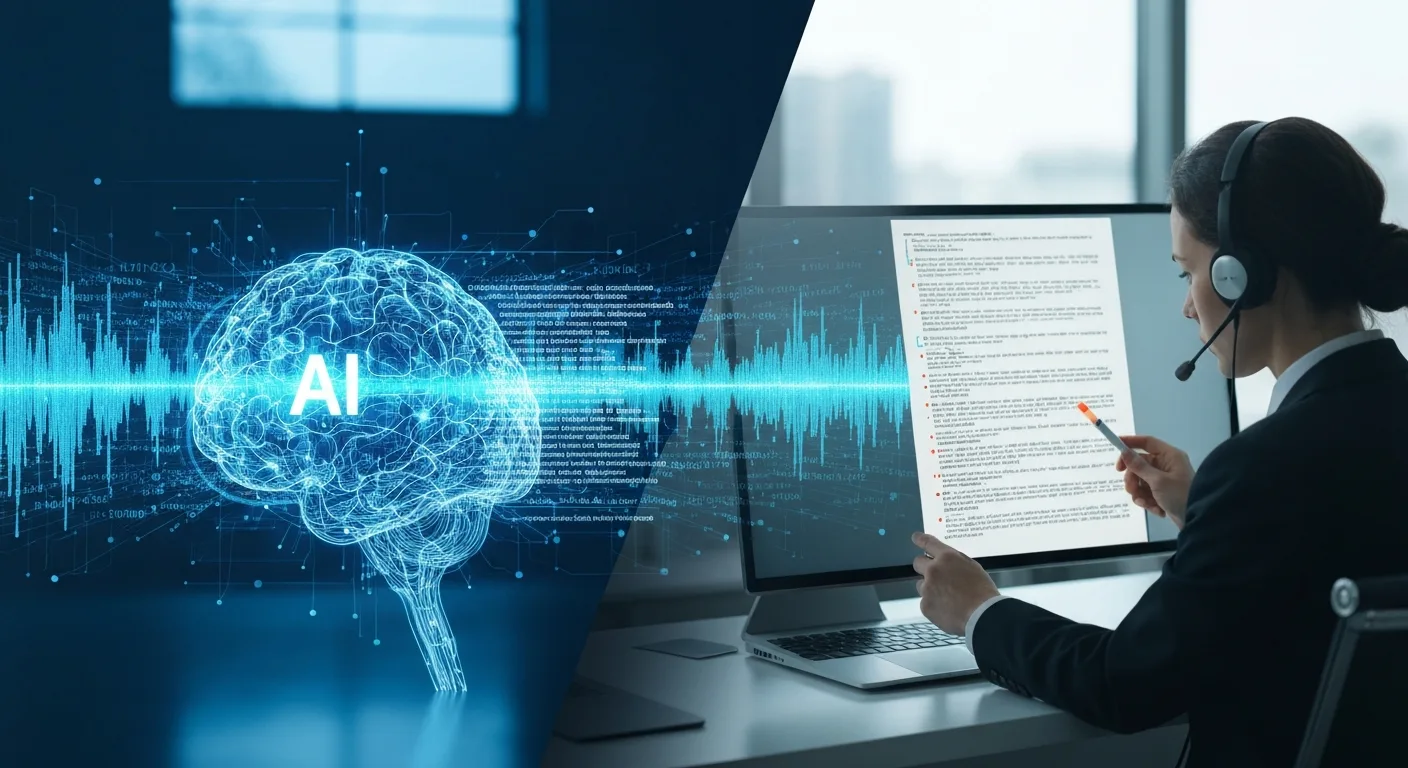
The Growing Challenge of Court Audio: Bodycams and 911 Calls
Over the last decade, the volume of audio and video evidence in the US legal system has exploded. For small law firms, solo clinicians conducting forensic evaluations, criminal justice researchers, and true crime podcasters, reviewing this media is a monumental task. A single criminal defense or personal injury case might involve dozens of hours of police body-worn camera (BWC) footage, dashcam recordings, and 911 dispatch calls.
Historically, transcribing this audio meant paying premium rates to specialized legal transcriptionists or forcing paralegals to spend days hitting rewind on foot-pedal software. Today, artificial intelligence has fundamentally changed how legal, medical, and research professionals process evidentiary audio. However, bodycam and 911 audio present unique acoustic challenges that even the most advanced AI cannot flawlessly solve alone.
Understanding what modern AI transcription engines can accomplish—and exactly where human review remains a non-negotiable requirement—is critical for maintaining legal admissibility, research integrity, and operational efficiency.
The Acoustic Nightmares of Evidentiary Audio
Unlike a controlled podcast studio or a quiet clinical setting, police bodycams and 911 calls are recorded in chaotic, high-stress environments. These recordings are notorious for acoustic issues that break traditional speech-to-text systems.
- Extreme Background Noise: Bodycams capture wind shear, passing traffic, sirens, and physical scuffles. 911 calls often feature screaming, barking dogs, or the sounds of an active incident in the background.
- Overlapping Speech: High-stress situations rarely feature polite turn-taking. Multiple officers, suspects, and bystanders frequently yell over one another, making it incredibly difficult to isolate individual speakers.
- Audio Compression and Codecs: 911 calls are often routed through legacy telecom infrastructure, resulting in low-bitrate, highly compressed audio. Bodycam microphones are optimized for durability, not high-fidelity sound, often clipping when voices reach high decibels.
- Emotional Distress and Dialects: Callers and suspects may be crying, out of breath, or speaking in heavy regional dialects and slang, drastically reducing acoustic clarity.
What Modern AI Transcription Can Do (The Tech Stack)
Despite these harsh conditions, the latest generation of AI speech recognition models has achieved remarkable breakthroughs. For US service businesses and researchers dealing with massive backlogs of audio, deploying the right AI technology can cut initial processing time by up to 90%.
When processing complex court audio, state-of-the-art platforms rely on a combination of advanced neural networks:
Whisper large-v3: Developed by OpenAI, the Whisper large-v3 model is widely considered the gold standard for noisy, complex audio. Because it was trained on millions of hours of diverse, multilingual, and often low-quality web audio, it excels at "guessing" the correct words in high-noise environments where older, strictly phonetic models fail. It is particularly adept at understanding heavy accents and muffled speech common in bodycam footage.
Deepgram Nova and AssemblyAI: For organizations that need to process thousands of hours of audio rapidly, API-driven models like Deepgram Nova and AssemblyAI offer incredibly fast, highly accurate alternatives. These models are optimized for enterprise-scale processing, offering specialized endpoints that can be tuned for conversational speech, making them highly effective for the rapid-fire exchanges found in 911 dispatch calls.
pyannote for Speaker Diarization: Transcribing the words is only half the battle; knowing who spoke them is just as critical in a legal context. Speaker diarization is the process of partitioning an audio stream into homogeneous segments according to the speaker identity. Open-source models like pyannote are frequently integrated into AI pipelines to separate "Speaker A" (the 911 dispatcher) from "Speaker B" (the caller), or to untangle the overlapping voices of multiple police officers on a scene.
Where Human Review is Non-Negotiable
While AI can generate a highly accurate first draft in minutes, it is not infallible. In the US legal system, transcripts used as evidence or for cross-examination preparation must meet strict standards of accuracy. Relying solely on raw AI output for bodycam and 911 audio carries significant risks.
AI Hallucinations in Low-Quality Audio
When AI models like Whisper encounter sections of audio that are completely unintelligible due to wind noise or static, they sometimes "hallucinate"—guessing words that were never spoken based on the surrounding context. In a legal setting, a hallucinated word can alter the entire meaning of a suspect's statement, potentially jeopardizing a case. Human reviewers are required to accurately tag these sections as [inaudible] or [unintelligible] rather than allowing the AI to guess.
Contextual and Phonetic Ambiguity
AI struggles with homophones and context-specific jargon. Did the officer say "he's fleeing" or "he's bleeding"? Did the 911 caller say "I shot him" or "I saw him"? A human reviewer, armed with the context of the case files and police reports, can make the correct determination where an AI might default to the statistically more common phrase.
Legal Certification
Under the Federal Rules of Evidence and most state court rules, a transcript introduced as an exhibit to assist the jury must generally be authenticated. Often, this requires a human transcriptionist or the attorney offering the transcript to certify its accuracy. AI cannot sign a certification under penalty of perjury; a human must verify the text against the audio.
Workflow Steps: Processing Bodycam and 911 Audio
For small law firms, solo forensic clinicians, and researchers, building an efficient workflow that combines AI speed with human accuracy is the key to managing court audio profitably. Here is the recommended step-by-step process:
- Step 1: Secure Ingestion. Upload the raw audio or video files into an encrypted, compliance-focused transcription platform. Ensure the platform supports various file types (MP3, WAV, MP4) as bodycam footage is often exported in proprietary or bulky video formats.
- Step 2: AI First-Pass Transcription. Run the audio through an advanced model (like Whisper large-v3) with speaker diarization enabled. This generates a time-stamped, speaker-separated draft in a fraction of the audio's real-time length.
- Step 3: Targeted Human Review. A paralegal, legal assistant, or researcher plays back the audio while reading the AI draft. The reviewer focuses heavily on crucial evidentiary moments: Miranda warnings, confessions, use-of-force commands, and 911 caller descriptions.
- Step 4: Formatting and Export. The finalized text is exported into a standard legal format (often requiring line numbers, specific margins, and speaker bolding) for use in depositions, trial prep, or research coding.
Compliance, Security, and Cross-Industry Parallels
Handling 911 calls and bodycam footage requires strict adherence to data security standards, much like handling sensitive medical data. In fact, for multi-disciplinary practices—such as solo clinicians doing forensic evaluations, home health agencies investigating patient incidents involving emergency services, or personal injury lawyers gathering medical records alongside police reports—the security requirements overlap heavily.
Just as healthcare providers rely on a HIPAA BAA (Business Associate Agreement) to ensure third-party vendors protect protected health information (PHI), legal and investigative professionals must ensure their transcription tools offer secure, encrypted environments that maintain the chain of custody. If a 911 call includes a caller discussing a victim's medical condition or severe injury, that audio crosses the line into sensitive health data.
Furthermore, professionals bridging the legal and medical fields must ensure their data pipelines are interoperable. A forensic psychiatrist analyzing a 911 call alongside clinical notes needs a system that respects CMS (Centers for Medicare & Medicaid Services) security guidelines. Ideally, the text generated from these evidentiary audio files should be easily formatted for EHR exports (Electronic Health Records) or structured using FHIR (Fast Healthcare Interoperability Resources) standards if the data is being integrated into a broader clinical or forensic patient profile. Choosing a vendor carefully and checking how recordings are stored helps ensure that whether you are processing a police interview or a sensitive clinical evaluation, the data remains private and compliant.
Pricing Math: AI vs. Human Transcription
The most compelling reason to adopt a hybrid AI-human workflow is the dramatic cost reduction. Traditional legal transcription services charge premium rates for bodycam and 911 audio because of the poor audio quality and multiple speakers.
Consider a small criminal defense firm or a university research team dealing with a backlog of 50 hours of bodycam and dispatch audio.
| Transcription Method | Estimated Cost Per Minute | Total Cost (50 Hours) | Turnaround Time |
|---|---|---|---|
| 100% Human Legal Transcriptionist | $3.00 - $4.50 (due to poor audio quality surcharges) | $9,000 - $13,500 | 2 to 4 weeks |
| Pay-as-you-go AI tools | Custom quote | Custom quote | 1 to 2 hours |
| Hybrid: AI + In-House Paralegal Review | AI Cost + Paralegal Hourly Rate ($40/hr for ~25 hours of review) | $150 (AI) + $1,000 (Labor) = $1,150 | 2 to 4 days |
By utilizing a pay-as-you-go AI transcription service for the heavy lifting, a firm or agency can save upwards of $10,000 on a 50-hour project, while still keeping the final quality control in-house where it belongs.
Decision Table: When to Rely on AI vs. Human Review
Not all audio requires the same level of scrutiny. Use this decision matrix to determine how to allocate your human review resources after the AI generates the initial transcript.
| Audio Type & Scenario | Recommended Approach | Rationale |
|---|---|---|
| Internal Case Triage / Discovery Review Reviewing 20 hours of bodycam to find the 5 minutes where an arrest occurred. |
AI Only (Searchable Draft) | High-speed AI processing allows you to use keyword searches (e.g., "gun", "stop", "Miranda") to find relevant timestamps without paying for human review on irrelevant hours of driving or waiting. |
| Research Interviews & Podcast Prep Analyzing transcripts of 911 calls for a criminal justice study or true crime script. |
AI + Light Human Spot-Check | General themes and quotes are needed, but strict legal certification is not required. Fix obvious AI errors and speaker misattributions, but verbatim perfection of background noise is unnecessary. |
| Trial Exhibits & Depositions Introducing a 911 call or bodycam confession as an exhibit in court. |
AI Draft + 100% Human Verification | Every single word matters. Human reviewers must verify the AI draft against the audio, accurately mark [unintelligible] sections, and prepare the document for formal legal certification. |
| Forensic Clinical Notes A solo clinician documenting a patient's erratic behavior captured on a 911 call for an evaluation. |
AI Draft + Clinician Review | Requires HIPAA-compliant handling. The clinician must verify the AI text to ensure medical symptoms or psychological indicators described in the call are transcribed with absolute clinical accuracy before EHR export. |
Optimize Your Court Audio Workflow Today
Processing bodycam footage, 911 calls, and complex evidentiary audio doesn't have to drain your firm's budget or your team's time. By leveraging advanced AI for the heavy lifting, you can reserve your valuable human resources for the high-level review and legal strategy that actually win cases and drive research forward.
If you are a solo clinician, small law firm, researcher, or podcaster tired of overpriced subscriptions and slow turnarounds, LessRec provides individually quoted, human-reviewed transcription for long, complex audio: an editor listens to the recording and checks the full transcript. Start streamlining your legal, clinical, and research audio workflows with LessRec today.
Lessrec provides human-reviewed transcription: an editor listens to the recording and checks the full text. Send your project requirements for an individual written quote.
Upload audio →