Label Speakers in Podcast Transcripts Without Mix-Ups
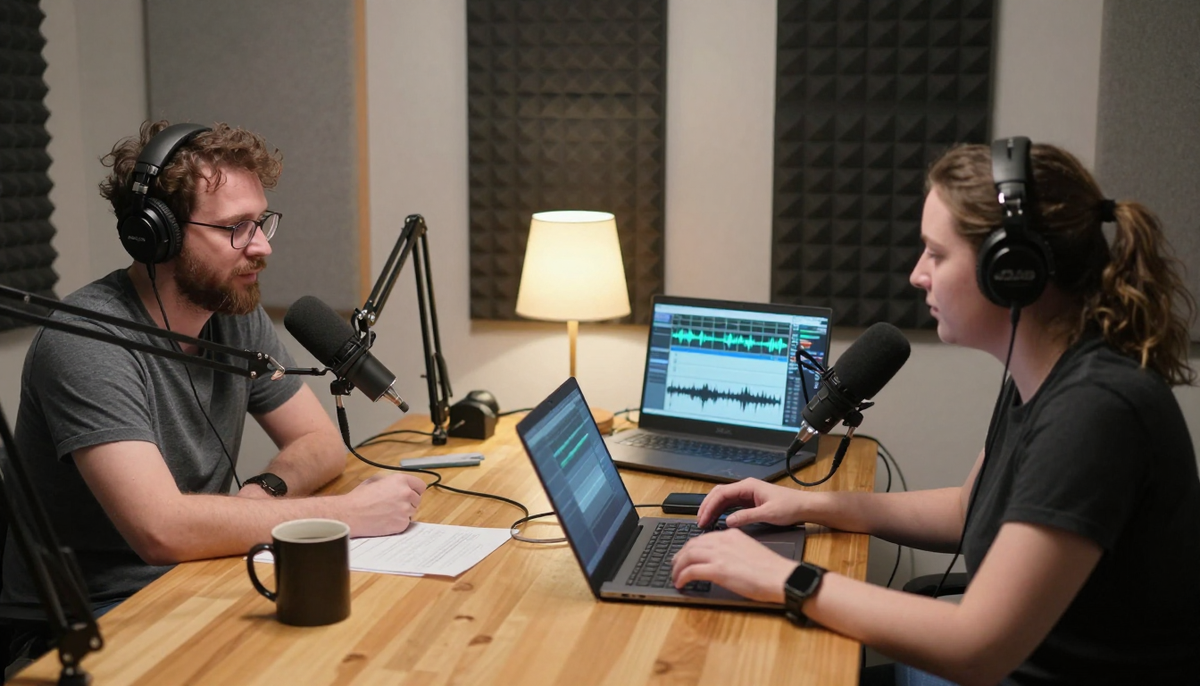
To label speakers in a multi-guest podcast transcript, give every voice a consistent full name at its first appearance, use short labels after that, and confirm each label by listening rather than guessing from the text. This guide is for podcasters, and for anyone else who turns a recording with several voices into a document: researchers running group interviews, small law firms reviewing recorded meetings, and clinicians or agencies recording case discussions. It explains why speaker confusion happens and what you can do before, during, and after recording to prevent it.
Why voices blur together: the cocktail party problem
In 1953, the British engineer Colin Cherry described what he called the "cocktail party problem": how a listener follows one voice in a room where several people are talking. He worked on it through listening experiments, including playing different messages into each ear. His question sounds trivial because people solve it every day without effort.
It is not trivial. Sound waves from every speaker arrive mixed into a single pressure signal at each ear. Nothing in the raw sound tells you which part belongs to whom. Your brain has to rebuild the separate voices using cues such as direction, pitch, vocal quality, rhythm, and meaning. In other words, separation is something the listener actively constructs. The recording does not deliver it.
Engineers have treated the problem as hard ever since. That has a direct consequence for your transcript. A recording, especially a mono mix, removes some of the cues your brain relies on, most obviously direction, because everyone comes out of the same speaker. Two guests who sounded completely different across a table can sound alike on playback.
The rest of this article applies that one principle. Speaker labeling is a reconstruction task, so your job is to keep as many identifying cues as possible and to add new ones where the recording loses them. That will hold for as long as people record conversations.
Have a recording that needs an accurate transcript? An editor listens to the full recording and checks the entire transcript. Send it for an individual quote.
How to prepare a recording so speakers can be identified
Most labeling problems are settled before anyone transcribes a word. Each habit below protects or adds a cue that would otherwise be lost.
- Record each person on a separate track when you can. This keeps the separation the mix would destroy.
- Ask each guest to state their name at the start. A spoken introduction ties each voice to a name for anyone who listens later.
- Use names on air. "Maria, what's your take?" works as a label inside the audio itself.
- Limit crosstalk. Overlapping speech is the hardest part of any recording to separate.
- Keep a speaker sheet. List every participant, the correct spelling of their name, their role, and a short voice note such as "lower voice, speaks quickly."
- Note late joiners and audience questions. Write down the approximate time so an unknown voice isn't left as "Unknown."
How to choose a speaker label format
Pick a format before transcription starts and use it throughout. Consistency matters more than the particular style.
| Format | Example | Best for |
|---|---|---|
| Full name, then first name | Maria Lopez: … then Maria: … | Public podcasts, show notes |
| Role labels | Host: … Guest 1: … | Drafts, or guests who prefer not to be named |
| Coded IDs | P1: … P2: … Interviewer: … | Research interviews where identities are protected |
Before you start, confirm these points:
- Every participant appears on the speaker sheet with a confirmed spelling.
- Labels are unique. Two guests named Chris need surnames or initials.
- One format is used for the whole file.
- You have a rule for overlapping speech, such as marking it [crosstalk].
- You have a rule for unclear attribution, such as [speaker unclear], instead of a guess.
Common mistakes and how to avoid them
Assigning labels from the text alone. A sentence that sounds like something the host would say is not proof that the host said it. Check attribution by listening.
Drifting labels. "Dr. Kim" becomes "Kim" and then "Guest 2" halfway through. Readers end up thinking there are three people. Set the format at the start and search the finished file for variants.
Merging similar voices. When two guests share a pitch and pace, a whole exchange can collapse into one speaker. Use your voice notes and the content of what is said to pull them apart.
Trusting an automatic draft's speaker tags. Automatic speaker separation runs into the same cocktail party problem. It may split one person into two or combine two people into one, especially during interruptions. Any machine-generated label should be treated as a guess until someone has checked it against the audio.
For example, imagine a panel episode with a host and three guests, two of whom have similar voices and keep finishing each other's sentences. An automatic draft might attribute a key opinion to the wrong guest. If that quote goes into show notes or a social post, you have put words in someone's mouth. Checking each turn against the audio, with the speaker sheet open, would catch the error before it is published.
What you can do yourself, and when to hand it off
You can reasonably label speakers yourself when there are two clear voices, the audio is clean, each person was on their own track, and you have time to listen through once with the transcript open. The checklist above covers most of what you need.
A professional transcription service makes more sense when:
- There are three or more speakers, frequent crosstalk, or similar voices.
- The recording is long and you can't give it a full, careful listen.
- Accurate attribution matters, as in research data, legal review, clinical discussions, or anything you'll quote publicly.
- You need a consistent format across many episodes or interviews.
Whichever route you choose, the principle is the same. Someone has to rebuild who said what by listening, using every available cue. Skipping that step doesn't make the problem go away. It only means nobody checks.
Get your multi-speaker recording transcribed by human editors
LessRec provides human-edited English transcription for podcasts, research interviews, legal recordings, and clinical dictation. Send your recording and speaker sheet to request an individual quote. We review the material and your requirements, and a manager confirms the quote in writing. As part of the ordered service, an editor listens to the full recording and checks the entire transcript, including speaker labels.
Related articles
- Transcribe Audio Evidence for Discovery With a Prep Checklist
- How to get accurate transcripts of dictated doctor's notes
- Deposition transcript checklist before you quote testimony
FAQ
How do you label speakers in a podcast transcript?
Give each voice a consistent full name at its first appearance, then use short labels after that. Confirm every label by listening to the audio rather than guessing from the text.
Why is it hard to tell voices apart in a recording?
A recording, especially a mono mix, removes cues your brain uses to separate voices, most obviously direction. Two guests who sounded different in the room can sound alike on playback.
Can I trust the speaker tags in an automatic transcript draft?
Treat machine-generated labels as guesses until someone checks them against the audio. Automatic separation can split one person into two or merge two people into one, especially during interruptions.
When should I use a professional transcription service for a multi-speaker recording?
Consider it when there are three or more speakers, frequent crosstalk, similar voices, or a long recording you can't listen to carefully. It also makes sense when accurate attribution matters, such as for research, legal review, clinical discussions, or public quotes.
Send your recording for an individual quote. An editor listens to the full recording and checks the entire transcript.
Request a quote →